

Tariffs + FBA Margin Squeeze 2026: How Amazon Sellers Are Adapting (and Where 3PLs Fit In)
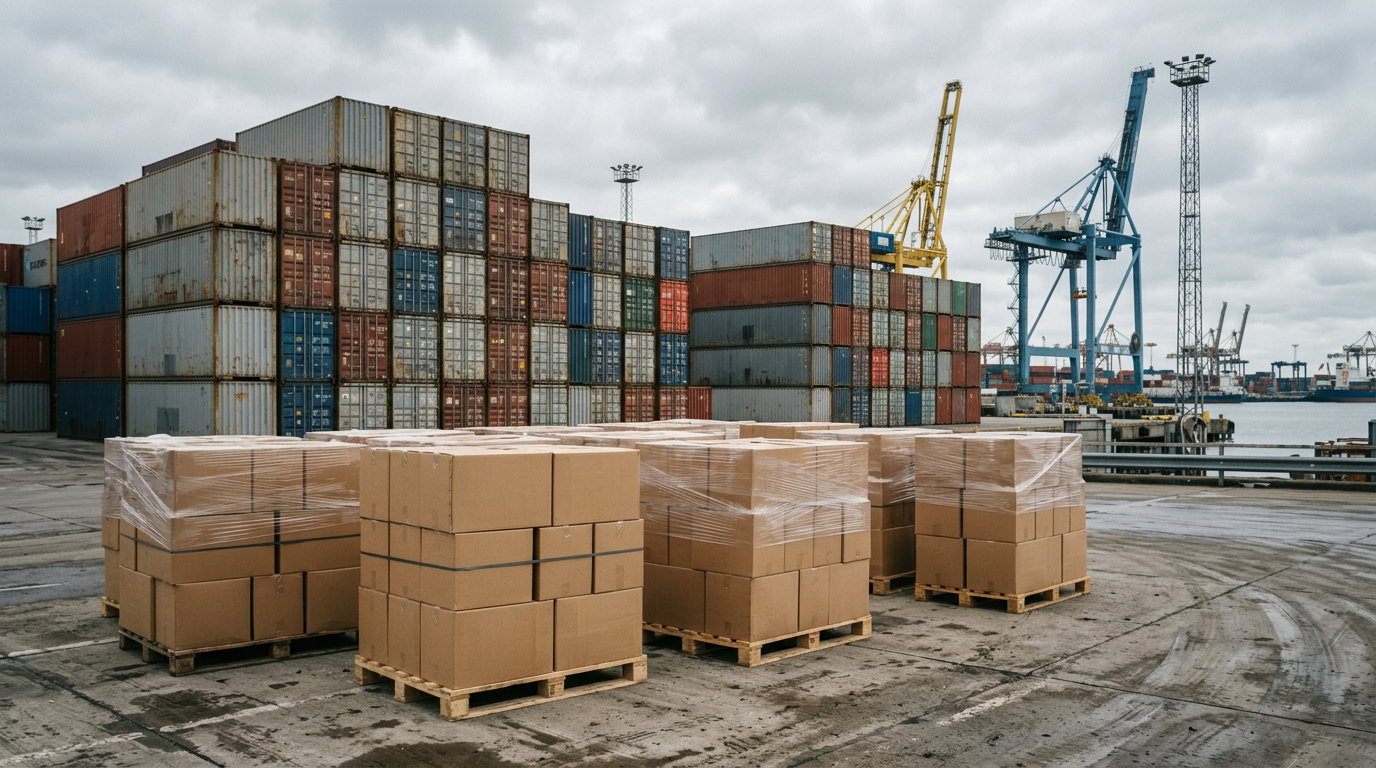
Tariffs + FBA Margin Squeeze 2026: How Amazon Sellers Are Adapting (and Where 3PLs Fit In)
Three separate cost pressures converged on Amazon FBA sellers in 2026 — almost simultaneously. Tariffs raised the cost of goods. Amazon raised fulfillment fees in January. Then Amazon added a 3.5% fuel and logistics surcharge in April. Each one alone would have been manageable. Together, they have turned the typical FBA P&L inside out.
This article breaks down every layer of that squeeze with real numbers, shows how sellers are responding, and explains how a US-based 3PL — specifically one positioned inside the Northeast Amazon fulfillment cluster — becomes a meaningful tool for margin recovery.
The Tariff Landscape: What Is Actually in Effect in 2026
The tariff environment in 2026 is not a single policy. It is four overlapping layers of duties that stack on top of each other and compound the total landed cost:
- Most Favored Nation (MFN) rate — the baseline WTO tariff, averaging around 3.3% on most consumer goods
- Section 301 tariffs — China-specific duties ranging from 7.5% to 100% by product category, first imposed in 2018 and expanded through a USTR four-year review in 2024
- IEEPA “fentanyl” tariff — a 10% surcharge on Chinese goods (reduced from 20% after the November 2025 US-China truce)
- Global reciprocal tariff — a 10% to 15% baseline on imports from virtually every country under Executive Order 14257 (April 2, 2025) and its July 2025 modification
For FBA sellers, what matters is the effective rate on their specific product category after all layers combine. The table below shows current blended effective rates for common FBA sourcing regions as of mid-2026:
| Sourcing Country | Section 301 Rate | IEEPA / Fentanyl Rate | Global Reciprocal Rate | MFN Baseline | Typical Blended Effective Rate |
|---|---|---|---|---|---|
| China (most consumer goods) | 7.5–25% | 10% | 15% | ~3.3% | 27–55%+ |
| China (electronics, apparel) | 25–100% | 10% | 15% | 0–32% | 35–72%+ |
| Vietnam | 0% | N/A | 20% | ~3% | 15–25% |
| India | 0% | N/A | 15% | ~3% | 15–25% |
| Mexico (USMCA-compliant) | 0% | N/A | 0% | 0% | 0–12% |
| EU / UK | 0% | N/A | 10% | ~3% | 10–15% |
| All other countries | 0% | N/A | 10% | ~3% | 10–15% |
Sources: China Briefing tariff analysis (April 2026); Baker Botts analysis of the July 2025 EO; US Tariff Calc FBA guide (April 2026).
The numbers for China deserve emphasis: a product category carrying 25% Section 301 duty now faces a combined effective rate of roughly 50–55% once IEEPA, global reciprocal, and MFN rates stack on top. For categories like apparel (MFN 10–32%) or electronics accessories, effective rates can reach 60–70%.
The De Minimis Door Is Closed
The $800 de minimis exemption — which previously allowed small-parcel imports to enter duty-free — is now suspended for all countries. China lost it on May 2, 2025. A July 30, 2025 executive order suspended it globally, and a February 2026 continuation order kept it suspended. The One Big Beautiful Bill Act codifies elimination for all countries by July 1, 2027.
This directly kills the direct-from-China dropship model. Sellers who relied on splitting orders into sub-$800 parcels now pay full duties on every unit. According to NBC News, Temu ceased shipments from Chinese factories to US consumers and restructured its entire model after the exemption ended.
The P&L Math: How Tariffs Flow Through to a Typical FBA Seller
Abstract tariff percentages are one thing. Watching them destroy your unit economics is another. Here is what the numbers look like for a seller running a mid-range private label product at a $25 retail price on Amazon, importing from China:
Pre-Tariff Baseline (2023)
| P&L Line Item | Amount | % of Revenue |
|---|---|---|
| Selling price | $25.00 | 100% |
| COGS (import from China, ex-tariff) | ($5.00) | 20% |
| Tariffs (pre-2025, ~7.5% Section 301) | ($0.38) | 1.5% |
| Freight & logistics to FBA | ($1.00) | 4% |
| FBA fulfillment fee (large standard) | ($5.00) | 20% |
| Amazon referral fee (15%) | ($3.75) | 15% |
| PPC / advertising | ($2.50) | 10% |
| Net margin | $7.37 | ~29.5% |
2026 Reality (Same SKU, Same Retail Price)
| P&L Line Item | Amount | % of Revenue | Change vs. 2023 |
|---|---|---|---|
| Selling price | $25.00 | 100% | — |
| COGS (import from China, ex-tariff) | ($5.00) | 20% | — |
| Tariffs (blended ~45% effective rate) | ($2.25) | 9% | +$1.87 |
| Freight & logistics to FBA | ($1.10) | 4.4% | +$0.10 |
| FBA fulfillment fee (Jan 2026 increase) | ($5.31) | 21.2% | +$0.31 |
| Fuel & logistics surcharge (3.5% of fulfillment) | ($0.19) | 0.7% | NEW |
| Amazon referral fee (15%) | ($3.75) | 15% | — |
| PPC / advertising | ($2.50) | 10% | — |
| Net margin | $3.90 | ~15.6% | −13.9 pts |
The same product. The same price. The same advertising spend. Net margin cut nearly in half — from ~30% to ~15-16% — driven almost entirely by tariffs stacking onto rising fulfillment costs. For sellers on thinner-margin SKUs (wholesale, arbitrage), this math turns negative quickly.
As Palmetto Digital Marketing Group’s FBA sourcing analysis put it: “A product that once had a healthy 30% margin may now be operating at 10–15%, or even lower if pricing cannot be increased due to competition.”
The Triple Squeeze: Tariffs + Fee Hikes + Fuel Surcharge
Sellers often process these three cost events as separate news items. In practice they are a single compounding problem that landed within months of each other:
| Pressure | Effective Date | Estimated Per-Unit Impact | Source |
|---|---|---|---|
| Tariff escalation (China blended effective rate) | April–August 2025 | +$1.50–$4.00+ on a $5 COGS item at 30–80% effective rates | China Briefing |
| FBA fulfillment fee increases (Jan 15, 2026) | January 15, 2026 | +$0.08/unit average; up to +$0.51/unit for items over $50 | Amazon Selling Partners |
| Inbound placement fee increase (Jan 15, 2026) | January 15, 2026 | +$0.05/unit average (minimal splits); $0.21–$0.68/unit standard, $2.16–$6.00+ bulky | AMZ Prep analysis |
| 3.5% fuel & logistics surcharge | April 17, 2026 | +$0.17/unit average (U.S. FBA); 3.5% applied to fulfillment fee base | Supply Chain Dive |
| De minimis elimination | May 2, 2025 (China); Aug 2025 (global) | Full duties now apply to all parcels; eliminates dropship arbitrage entirely | White House EO |
Using the SPS Commerce analysis of the April 2026 changes, a $20 large-standard product that fulfilled at $5.04 per unit now costs $5.22 after the fuel surcharge — before the placement fee even enters the calculation. Stack placement fees on top, and a minimal-split shipment adds another $0.38–$0.68 per standard-size unit.
FASTFBA3PL’s breakdown of the 3.5% surcharge walks through exactly how these charges compound on different size tiers and why the stacking effect matters more than the headline average.
How Amazon Is Responding
Amazon’s response to the tariff environment has been instructive — and somewhat contradictory. The company is protecting its own economics while simultaneously trying to maintain consumer price perception.
Amazon Haul: The China-Lite Model Gets Complicated
Amazon Haul launched as a direct competitor to Temu and Shein, offering products priced under $20 shipped directly from Chinese manufacturers. Tariffs and the end of de minimis have forced a strategic pivot. Amazon began adding brand-name inventory from US warehouses — Levi’s, Adidas, Gap — to replace the direct-from-China model that no longer pencils out. The ultra-low-price value proposition that Haul was built around has become structurally impossible to deliver from China at scale.
Amazon also considered — and quickly walked back — displaying tariff-related surcharges on Haul product pages, after the White House publicly criticized the concept.
Buy with Prime: The FBA Inventory Monetization Play
Amazon has been accelerating Buy with Prime enrollment to extract more value from FBA inventory already inside its network. Retail Brew reported in March 2025 that Amazon is actively pushing Buy with Prime signups to increase FBA utilization and capture off-Amazon fulfillment revenue. The January 2026 MCF preferred pricing program formalized this — offering fee discounts to sellers who route significant off-Amazon volume through FBA inventory.
Fee Structure: Amazon Protects Its Margins
The January 2026 fee hikes and the April 2026 fuel surcharge tell a clear story: Amazon is insulating its own margins from the same cost pressures hitting sellers. As SPS Commerce noted, the pattern of changes — payout delays, fuel surcharges, ad billing restructuring — collectively “protect Amazon’s own margins while asking sellers to carry more of the burden.”
Four Ways Sellers Are Adapting
1. Sourcing Pivot: Nearshoring and Diversification
The most structural response is relocating the supply chain. Sellers are moving production to countries with lower effective tariff rates:
- Mexico — USMCA-compliant products enter the US at 0% duty. Mexico surpassed China as the largest US import partner in 2024 at $466.6 billion. Proximity means ground freight from border to US fulfillment centers in days, not weeks.
- Vietnam — US imports from Vietnam reached $136.6 billion in 2024, up 19.3% year-over-year. New 20% reciprocal tariffs (effective August 2025) reduced the advantage over China, but 15–25% effective rates still beat China’s 35–72% range for most consumer goods.
- India — Particularly strong for textiles, home goods, leather, and handicrafts. India’s textile sector is targeting $350 billion by 2030. Effective US tariff rates land at 15–25% for most categories.
A CNBC-reported kitchen appliance seller was “moving as fast as we can” to shift production to India and Mexico while temporarily raising prices. Vietnam diversification has cut COGS by 14% for some sellers without sacrificing quality, according to sourcing consultants.
The dominant framework is “China Plus One” — maintain Chinese supplier relationships for complex or high-tech goods where no viable alternative exists, while shifting commodity and mid-complexity SKUs to Vietnam, India, or Mexico. A US-based 3PL in the Northeast becomes critical infrastructure for the nearshored model — acting as the domestic hub where Mexico or India-sourced inventory lands, gets prepped, and flows into Amazon’s network.
2. Hybrid FBA + FBM via 3PL
Running pure FBA on every SKU made sense when margins were wide. In a compressed margin environment, sellers are stratifying their catalog: fast-moving, higher-margin SKUs stay in FBA for Prime eligibility, while slower-moving or margin-thin SKUs shift to Fulfilled by Merchant (FBM) or Multi-Channel Fulfillment (MCF) from a 3PL warehouse.
FBM from a 3PL eliminates placement fees, reduces storage costs (3PL rates are typically lower than Amazon’s Q4 surge pricing), and keeps capital flowing faster. MCF preferred pricing, introduced January 15, 2026, allows sellers routing 1,200+ units through FBA inventory to off-Amazon channels to receive up to 15% off MCF fees plus up to $1 in FBA credits per unit.
3. SKU Rationalization
Margin compression forces catalog discipline. Sellers are systematically identifying which SKUs can no longer carry the tariff burden and cutting them. The filter is simple: if the product cannot absorb a 15–40% COGS increase without either pricing above market or going margin-negative, it exits the catalog. This is painful in the short term but frees up working capital and warehouse bandwidth for products that can actually generate sustainable returns.
FASTFBA3PL’s 2026 prep cost comparison illustrates how per-unit cost analysis at the SKU level reveals which products are worth keeping in the FBA channel versus transitioning to FBM or discontinuing.
4. Pricing Power and Premium Positioning
For sellers with differentiated products, the tariff environment paradoxically creates opportunity. Tariffs hit commodity products hardest. A seller with a proprietary formulation, unique design, or strong brand moat has pricing power that pure arbitrage sellers lack. Sellers who have taken prices up 20–30% to offset tariff costs have found that strong-brand products absorb the increase better than expected. The tariff squeeze is accelerating the separation between commodity sellers (who are getting crushed) and brand builders (who can pass through costs).
Where a US-Based 3PL Fits: The Margin Recovery Math
A 3PL is not just a warehouse. In the 2026 tariff environment, it is a three-lever margin recovery tool. Here is how each lever works for a seller shipping through a prep center like FASTFBA3PL in Huntingdon Valley, PA — 18.6 miles from ABE8 and within 2 hours of 19 Amazon fulfillment centers.
Lever 1: Bypass Inbound Placement Fees
Amazon’s inbound placement fees are now one of the most significant hidden costs in the FBA model. When you send inventory to a single location (minimal split), Amazon charges:
- $0.21–$0.68 per unit for standard-size products
- $2.16–$6.00+ per unit for large bulky products
Amazon-optimized splits — where you send to 4+ locations — drop the placement fee to $0. But managing multi-destination shipments from an overseas freight forwarder is logistically complex and expensive.
A domestic 3PL positioned inside the Amazon FC cluster solves this. FASTFBA3PL can receive your consolidated shipment, perform prep and inspection, then route units to Amazon-optimized destinations via UPS SPD (1 business day within ~150 miles, covering NJ, DE, MD, PA, DC, CT, most of NY and VA) or direct LTL/FTL to the dock. You pay zero placement fees because you are meeting Amazon’s optimized split criteria — and your freight costs are lower because the 3PL is already adjacent to the FCs.
On a 5,000-unit shipment of large standard items, placement fee savings alone can reach $3,000+ at the minimal-split rate — savings that directly offset tariff cost increases.
Lever 2: Enable FBM / MCF on Margin-Sensitive SKUs
A 3PL gives sellers a physical US base for FBM fulfillment. Instead of holding all inventory inside Amazon’s network, you hold safety stock at the 3PL and fulfill orders from there when FBA placement costs or Amazon storage rates make it uneconomical to keep items at FBA.
This is particularly powerful for:
- Seasonal SKUs that would otherwise incur aged inventory surcharges
- Slow-moving SKUs where FBA long-term storage fees erode any remaining margin
- New launches where you are testing demand before committing to FBA inventory
- Multi-channel sellers who want to use Amazon inventory to fulfill Shopify, Walmart, or TikTok Shop orders via MCF preferred pricing
Lever 3: Faster Cash Conversion Cycle
Cash flow is the hidden casualty of the tariff squeeze. When inventory is stuck at FBA, capital is locked. The average FBA check-in time can run 18–28 days. Inventory at a 3PL adjacent to Amazon FCs can be received, prepped, and in the Amazon receiving queue within 1–2 business days. Faster inventory turns mean less working capital tied up at any given moment — critical when tariff payments have already strained cash flow at the point of import.
The Nearshoring Bridge
For sellers executing the Mexico-to-US nearshoring strategy, a PA-based 3PL becomes the literal bridge between production and Amazon’s network. Goods manufactured in Mexico move by ground freight to Huntingdon Valley, undergo prep and inspection (labeling, bundling, kitting), and enter Amazon’s Northeast fulfillment cluster — the densest concentration of FCs in the United States. Pennsylvania alone hosts 47 Amazon facilities (26 FCs and sortation centers plus 21 delivery stations), with 8 large FCs over 600,000 sq ft.
| Margin Recovery Lever | Mechanism | Estimated Per-Unit Impact |
|---|---|---|
| Bypass placement fees | Route consolidated inbound through 3PL → Amazon-optimized split | Save $0.21–$6.00+ per unit depending on size tier |
| FBM on slow/margin-thin SKUs | Hold at 3PL, fulfill via FBM or MCF; avoid FBA storage & aged inventory fees | Save $0.30–$2.40/ft³/month storage + avoid aged surcharges |
| Faster cash conversion | 1–2 day check-in vs. 18–28 day FBA receiving backlog | Reduced working capital requirement; faster inventory turns |
| Nearshored inventory hub | Mexico/India freight to PA → prep → 19 FCs within 2 hours | USMCA 0% tariff + lower freight vs. trans-Pacific |
Action Playbook for Q3 2026
The sellers who come out of this environment with healthy margins will be the ones who treated Q3 2026 as a restructuring quarter rather than a waiting quarter. Here is a prioritized sequence:
- Run a SKU-level tariff audit. Calculate the effective tariff rate on every active ASIN. Identify which products now carry a combined COGS + tariff burden above 35% of selling price. Those are your margin-risk SKUs.
- Kill margin-negative SKUs immediately. Continuing to sell at a loss while hoping for policy relief is not a strategy. Price up or liquidate. The capital freed up is worth more than the revenue.
- Quantify your placement fee exposure. Pull your FBA settlement reports. Calculate total inbound placement fees paid in the last 90 days. If you are paying $0.30+ per unit on minimal splits, that is the first dollar-for-dollar offset available to you by routing through a 3PL.
- Initiate at least one alternative sourcing conversation. Request quotes from a Vietnam, India, or Mexico-based manufacturer for your top-tariffed SKUs. You do not have to switch — you need the landed cost comparison to make an informed decision.
- Segment your FBA vs. FBM catalog. Identify which SKUs genuinely need Prime eligibility versus which ones are paying for FBA unnecessarily. Move slow-moving inventory to FBM via a 3PL. Keep FBA focused on velocity and margin.
- Build nearshoring logistics infrastructure now. The sellers who win in 2027 started their Mexico or India supply chain relationships in Q3 2026. Establishing a 3PL as your US hub before you need it — not after you are in crisis — is how you execute the transition without stockouts.
The Bottom Line
The 2026 FBA environment is not a temporary disruption. Unicargo’s analysis of the post-de minimis landscape frames it clearly: sellers face 15–40% cost increases on many categories, and the policy framework that enabled direct-from-China models is not coming back. The sellers who adapt — through sourcing diversification, hybrid FBA/FBM strategies, SKU rationalization, and infrastructure built for the new cost structure — will gain durable competitive advantages as their slower-moving competitors continue to absorb margin erosion.
A US-based 3PL positioned inside Amazon’s densest FC network is not an expense. In the 2026 tariff environment, it is an offset. Placement fees bypassed, faster inventory turns, FBM capability on margin-thin SKUs — these translate directly to recovered margin points at a time when every point matters.
FASTFBA3PL operates a 12,000 sq ft warehouse in Huntingdon Valley, PA — 18.6 miles from ABE8, with 19 Amazon FCs reachable by truck within 2 hours. Our team processes orders within 24 hours and ships via UPS SPD or direct Amazon LTL/FTL, giving your inventory the fastest possible path from receipt to Amazon’s receiving queue.
If tariffs are compressing your FBA margins and you want to understand exactly where a 3PL fits in your specific catalog, reach out to the FASTFBA3PL team here. We will walk through your shipment volumes, size tiers, and current fee structure to show you the actual per-unit savings available to your business.